
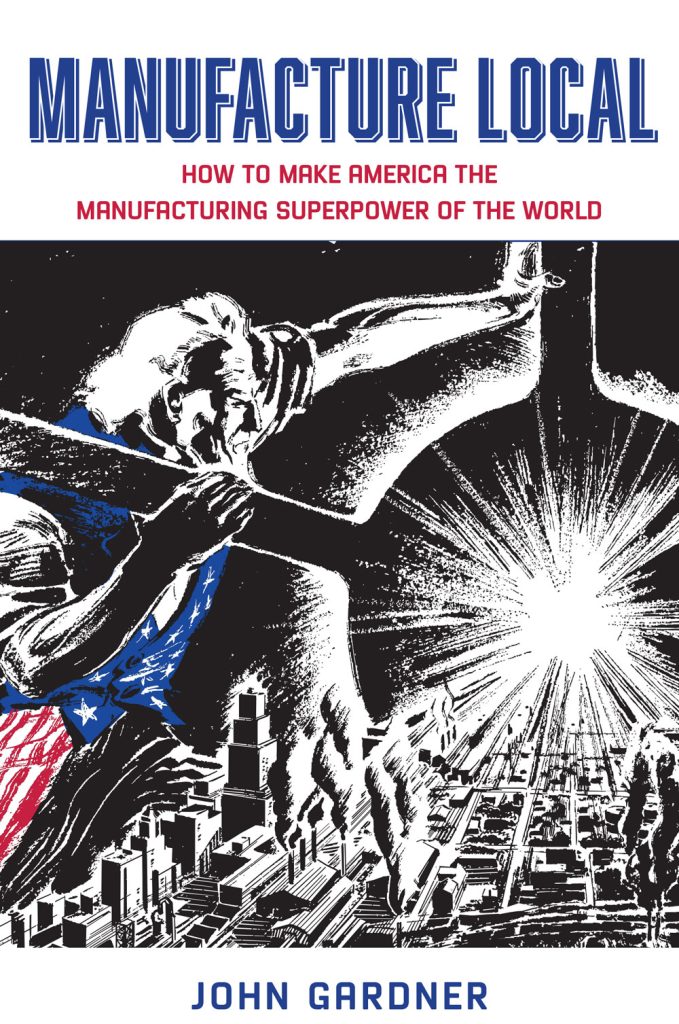
MANUFACTURE LOCAL
How to Make America the Manufacturing Superpower of the World
In Manufacture Local, John Gardner details the positive policy steps that American political leaders should champion to reinvigorate America’s core industry. He examines manufacturing’s importance to national security, to America’s sense of self-sufficiency, and to the flourishing of its great cities. He scrutinizes free trade as it is commonly understood and proposes steps to take toward a production-based economy in which tariffs protect and encourage American greatness. And drawing on his nearly two decades of experience working with manufacturers, Gardner proposes workable solutions to make up for America’s crisis of skilled labor.
Manufacturing is often denigrated as low work for uneducated people, yet nothing could be further from the truth. It’s time America gives the industry its proper respect, but the only way that will happen is if it speaks up for itself. Gardner does just that; he raises a voice of hope for every American to hear. By sharing lessons from his own life—and telling the untold story of American manufacturing—he emphasizes the importance of manufacturing, not just to the American economy but also to our entire way of life.
Manufacture Local presents a formula for success. It’s time to make America the manufacturing superpower of the world again.
WHAT YOU WILL LEARN
Key Themes & Arguments
Importance of Manufacturing
To national security, self-reliance, and middle-class strength
Addressing Crisis
Addressing the skilled labor crisis and how to revitalize American craftsmanship
Creating a Movement
For manufacturing pride and renewing America’s industrial base
KIRKUS REVIEWS
Gardner calls for a renewed national emphasis on manufacturing in this concise treatise and ode to “the unsung strength of America’s core industry.”
Nuanced in its analysis, the work blames the weakening of American manufacturing both on corporate and government policy. Per Gardner, the outsourcing of labor, complacency regarding “shoddy workmanship,” and corporate mismanagement (combined with a growing emphasis in the 1980s and ’90s on free trade) led to a precipitous decline in American manufacturing.
An optimist by nature, the author still has a “fundamental hope for our country” and puts forth a multi-chapter analysis of the ways in which “we can still save manufacturing and, in doing so, rebuild America.”
Central to the book’s vision is what Gardner calls “America-first capitalism,” which rejects the unilateral free trade vision of conservative economists like Milton Friedman as well as the principles of globalization endorsed by neoliberals. (In particular, the book endorses tariffs on foreign goods.)
According to the author, embracing this approach would not only bolster American jobs but also strengthen America’s national security by making it less dependent upon rival nations like China for things that range from medical supplies to the raw materials needed for infrastructure revitalization.
Another proposition calls for the redirection of educational priorities away from college degrees toward trade schools and on-the-job experience—the author posits that “there are too many head chefs in the kitchen and not enough prep cooks, dishwashers, and line cooks.”
A well-argued defense of U.S. manufacturing.
WHY THIS BOOK
Author & Context
John Gardner is an entrepreneur and autodidact with two decades of experience in American manufacturing. After a traumatic injury as a teenager, he dropped out of high school and left Ohio to pursue his dreams in California. He slept in his car, ate canned food, and worked at restaurants. At the age of twenty-five, he started a business out of his apartment based on a cutting tool his father had engineered. By overcoming adversity with determination and tenacity, he now sells his product to the US Navy, NASA, Lockheed Martin, Ford Motor, the FAA, and thousands of other companies.

The Wall Street Journal
Former Trump White House chief strategist Steve Bannon and pro-tariff author John Gardner developed the idea of the “external revenue service,” and then introduced it to one of Trump’s aides, according to a person familiar with the matter.
Booklife
- takes on such economic titans as Milton Friedman, Thomas Sowell, and Paul Krugman in his defense of tariffs and criticism of so-called free and fair trade, which he calls “disastrous” and “the destruction of countless family-built American businesses...